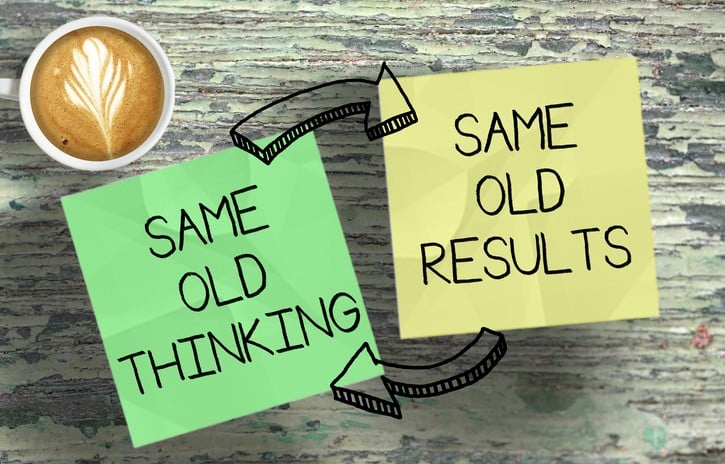
You finally sit down to relax, and suddenly your brain starts replaying the same conversation, worry, mistake, or worst-case scenario on repeat. You try to “think your way out of it,” but somehow the loop only gets louder.
If this sounds familiar, you’re not alone.
Racing thoughts and repetitive thinking—often called rumination or thought loops—are incredibly common, especially during periods of stress, anxiety, overwhelm, grief, burnout, or uncertainty. The good news? Your brain is not broken. More importantly, there are practical ways to interrupt the cycle.
Heather Hurlock, writing for Super Age, explains that the goal is not to stop thinking altogether. The real work is learning not to fight your mind. Instead of becoming trapped inside the thought, we can learn to observe it with a little more space and awareness.
One of the most powerful shifts is recognizing this simple truth:
You are not your thoughts.
You are the awareness noticing the thoughts.
That distinction matters more than most people realize.
Researchers describe this skill as “decentering,” meaning the ability to step back and observe your thinking instead of automatically believing every thought your mind produces. Studies show this reduces emotional reactivity and supports emotional regulation.
So what can you actually do when your mind gets stuck?
1. Name the Thought Instead of Wrestling with It
One of the fastest ways to interrupt a thought loop is surprisingly simple: label it.
Instead of saying:
“I’m failing.”
Try:
“I’m worrying.”
“I’m catastrophizing.”
“I’m replaying.”
“I’m comparing.”
This tiny shift helps your brain move from emotional overwhelm into observation.
Heather Hurlock cites UCLA research showing that naming emotions or mental states can calm the brain’s alarm system. In studies, people who labeled their feelings showed decreased activity in the amygdala—the brain’s fear center—and increased activity in areas involved in emotion regulation. In other words, naming the experience softens it by engaging the brain’s prefrontal cortex — the area involved in emotional regulation, reasoning, and self-control — while calming the brain’s alarm system.
2. Get Out of Your Head and Into Your Body
Thought loops live in the mind, but mindfulness begins in the body.
When your nervous system is activated, your brain searches for problems to solve. That is why grounding techniques work so well. They help signal safety.
Try:
- Taking a slow walk outside
- Holding something cold
- Stretching or shaking out tension
- Focusing on your breathing
- Naming five things you can see, hear, smell, taste, or feel
- Putting both feet firmly on the floor
Even a few minutes of physical grounding can interrupt the momentum of spiraling thoughts.
3. Stop Treating Every Thought Like a Fact
Not every thought deserves your trust.
Many repetitive thoughts are simply mental habits—old fears, protective patterns, self-criticism, or anxious predictions replaying automatically. Research on rumination shows that repetitive negative thinking often strengthens anxiety and depression rather than solving problems.
A helpful question to ask yourself is:
“Is this thought helping me right now?”
If the answer is no, you do not have to keep following it.
Thoughts are mental events, not always reality.
4. Shift From Judgment to Curiosity
Most people respond to racing thoughts with frustration:
“Why am I like this?”
“I need to stop thinking.”
“What’s wrong with me?”
But criticism tends to increase the loop.
Curiosity helps loosen it.
Instead, try asking:
- What triggered this?
- What emotion is underneath this thought?
- What am I needing right now?
- Is my body exhausted, overstimulated, lonely, or stressed?
Sometimes the thought loop is not the real issue. It may simply be the signal that your nervous system needs care, rest, reassurance, boundaries, or support.
5. Remember: The Brain Repeats What It Rehearses
Researchers studying rumination have found that repetitive thinking strengthens mental pathways through repeated retrieval of the same memories and emotional patterns. In simple terms: the more we rehearse certain thoughts, the easier they become to replay automatically.
That means every time you gently redirect your attention—to your breath, your body, a task, gratitude, prayer, movement, music, or connection—you are helping build different neural pathways.
You are teaching your brain a new rhythm.
Final Thoughts
A racing mind often believes that if it thinks hard enough, long enough, or analyzes deeply enough, it will finally feel safe.
But peace rarely comes from overthinking.
It comes from creating enough space between you and the thought that you no longer feel consumed by it.
Notice the thought.
Name it.
Ground yourself.
Get curious.
Then gently return to the present moment again.
You do not have to win the argument with your mind to find calm. Sometimes you simply have to stop giving every thought the final word. Want help with stopping your thought loops?
Be mindful. Be curious. Be well.
References
Hurlock, H. (2024). Stuck in a thought loop? Here’s what actually helps. Super Age
Nolen-Hoeksema, S., Wisco, B. E., & Lyubomirsky, S. (2008). Rethinking rumination. Perspectives on Psychological Science, 3(5), 400–424. https://doi.org/10.1111/j.1745-6924.2008.00088.x
Lieberman, M. D., Eisenberger, N. I., Crockett, M. J., Tom, S. M., Pfeifer, J. H., & Way, B. M. (2007). Putting feelings into words: Affect labeling disrupts amygdala activity in response to affective stimuli. Psychological Science, 18(5), 421–428. https://doi.org/10.1111/j.1467-9280.2007.01916.x
Arulchelvan, E., et al. (Research contributor). Studies on rumination and repetitive negative thinking. Trinity College Dublin Digital Commons