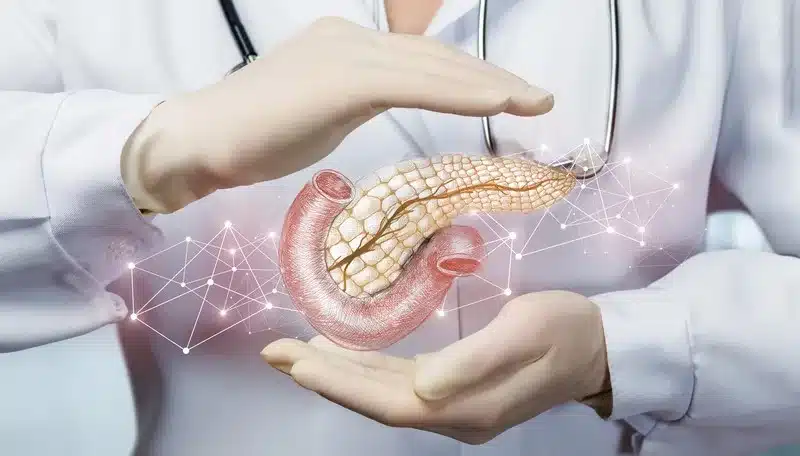
The pancreas plays two vital roles: it releases enzymes that aid in digesting food (exocrine function), and it secretes hormones, such as insulin and glucagon, that regulate blood sugar levels (endocrine function). Protecting your pancreas is paramount because it is located deep in the abdomen, where disease remains undetected until the late stages. While some damage can heal, much cannot—making prevention and early action paramount for protection.
In this article, you will learn how to keep your pancreas healthy. You’ll learn steps on how to protect your pancreas to prevent common pancreas-related illnesses such as pancreatitis or pancreatic cancer. Keep reading for a healthier pancreas.
What is the Pancreas & Where is it Located?
Before you learn how to protect the pancreas, you need to know what it is and where it’s located in your body.
The pancreas is an oblong, glandular organ located behind the stomach. It’s in front of the spine and surrounded by the liver, gallbladder, and the gastrointestinal tract. The pancreas plays two significant roles in the body:
- Exocrine System: Produces and releases digestive enzymes (such as amylase, lipase, and proteases) into the small intestine to help break down carbohydrates, fats, and proteins during digestion. In fact, the pancreas produces about 1–4 liters of enzyme-rich juice every day to help you properly digest food.
- Endocrine System: Produces and releases hormones, primarily insulin and glucagon, directly into the bloodstream to regulate blood sugar (glucose) levels. If your blood sugar is too high, the pancreas makes insulin to lower it. On the other hand, if it’s too low, your pancreas produces glucagon to increase it.
The pancreas also supports other vital organs, including the kidneys, liver, and heart.
How Damage Happens to the Pancreas
There are primarily three ways the pancreas gets damaged:
- Type 2 Diabetes (T2D) develops from chronic overnutrition, insulin resistance, and inflammation, which overworks insulin-producing β-cells. Early in the disease, these cells often become “dysfunctional” rather than destroyed. If caught early, lifestyle changes can help reverse the condition.
- Pancreatitis is an excruciating acute inflammation of the pancreas, often from gallstones, alcohol excess, or very high triglycerides, which can damage tissue. Repeated episodes can lead to chronic pancreatitis and permanent scarring.
- Pancreatic cancer, which usually develops silently, has risk factors that include smoking, chronic pancreatitis, obesity, and specific genetic mutations.
There are other common symptoms of pancreatic problems, including the following:
- Blurred vision
- Abdominal pain
- Extreme thirst or frequent urination
- Nausea and vomiting
- Back pain
- Fatigue
- Tingling in your hands or feet
- Unexplained weight loss
If you’re experiencing these symptoms, it’s best to seek professional healthcare or meet with a functional medicine practitioner to address the root causes.
Functional medicine specialists can often conduct physical health tests that help reveal whether your pancreas may be involved. Blood tests can reveal levels of glucose, amylase, and lipase, markers used in assessing overall metabolic health and pancreatic enzyme activity. Nutrition and stool testing can also be beneficial, providing insight into digestion and gut health, which can be affected by pancreatic enzyme issues.
In addition to these, more pancreas-specific tests that your healthcare provider might order include:
- The fecal elastase test is a stool test that measures pancreatic enzyme output and can help indicate exocrine pancreatic insufficiency.
- Pancreatic function tests like the secretin stimulation test (also called a pancreatic function test) measure how well your pancreas responds to stimulation.
- Imaging tests, such as ultrasound, CT scan, MRI/MRCP, and endoscopic ultrasound (EUS), can visualize the pancreas and detect structural issues, including inflammation, blockages, or tumors.
- Oral glucose tolerance tests or mixed meal tolerance tests, which help evaluate how well the pancreas is producing insulin as part of endocrine function and blood sugar regulation.
These tests, used in conjunction with clinical evaluation, can provide a much clearer picture of whether symptoms are associated with pancreatic dysfunction.
Reversibility: How Much Is Possible?
Research shows nuance. Some metabolic dysfunctions are modifiable, but structural scarring or cell loss is usually not.
Patients with Type 2 Diabetes, who participated in intensive weight-loss programs, such as the UK DiRECT trial, found that approximately 46% of participants with early T2D achieved remission (HbA1c <6.5% without medication) after one year of substantial calorie reduction and sustained weight loss. Bariatric surgery studies indicate remission rates ranging from 30% to 60%, depending on factors such as age, disease duration, and baseline weight. The likelihood of β-cell recovery declines sharply after ~10 years of poorly controlled type 2 diabetes (T2D). Research directed to pancreatitis suggests that mild acute cases can heal completely if triggers (e.g., gallstones, alcohol) are addressed.
Persistent pancreatitis leads to irreversible fibrosis; treatment focuses on pain control, enzyme replacement, and managing diabetes. Regarding Type 1 Diabetes research, autoimmune β-cell destruction is currently irreversible without experimental therapies such as islet or stem-cell transplants.
Finally, and unfortunately, established pancreatic cancer cannot be “reversed,” though early detection improves survival.
How to Protect Your Pancreas Naturally: 7 Evidence-Based Steps
While some pancreas-related illnesses are reversible, not all are. So, what’s the best way to prevent these illnesses from happening in the first place?
Here’s how you can protect your pancreas naturally starting today:
- Maintain a Healthy Weight and Waistline. Central obesity is strongly linked to insulin resistance. Aim for a body-mass index in the 18.5–24.9 range or a waist circumference <35 in (women) or <40 in (men), adjusting for individual context.
- Adopt a Whole-Food, Low-Added-Sugar Diet. Emphasize vegetables, fruits, legumes, lean proteins, nuts, and whole grains. Limit sugar-sweetened beverages and refined carbohydrates, which can raise blood glucose and triglyceride levels.
- Exercise Regularly. At least 150 minutes of moderate aerobic activity per week, plus resistance training, improves insulin sensitivity and lowers triglyceride levels.
- Limit Alcohol. Heavy drinking is a leading cause of chronic pancreatitis. If you drink, keep it to ≤1 drink/day for women and ≤2 for men.
- Don’t Smoke. Smoking roughly doubles the risk of pancreatic cancer.
- Manage Triglycerides and Blood Pressure. High triglycerides (>500 mg/dL) can trigger pancreatitis. Work with your healthcare provider to address underlying causes and implement lifestyle changes.
- Get Regular Check-ups. Early detection of prediabetes or elevated triglycerides allows intervention before damage accumulates.
Learn How to Protect Your Pancreas & Live a Healthy Lifestyle
Prevention is paramount. Protecting your pancreas can prevent numerous illnesses and help you feel your best long term. Take small steps, such as incorporating a regular workout routine or consulting a healthcare provider regularly, to help maintain a healthy pancreas.
For families seeking a more holistic approach, The Woodlands Institute for Health & Wellness in The Woodlands, Texas, offers comprehensive health solutions rooted in functional medicine and science-backed traditional practices. By combining natural therapies with personalized care, we empower women, men, teens, and children to address root causes and build sustainable, lifelong wellness.
If you’d like natural solutions for a damaged pancreas or would like to prevent pancreas-related illnesses, our specialists can create a personalized health treatment plan tailored to your needs. Contact us for tailored, functional medicine healthcare.
References
Lean, M. E. J., et al. (2018). Lancet, 391(10120), 541–551.
Levels.com. Weekly Blog. Can pancreatic damage be reversed? July 25, 2025
Mingrone, G., et al. (2021). New England Journal of Medicine, 384(12), 1093–1102.
Yadav, D., & Lowenfels, A. B. (2013). NEJM, 368, 2072–2080.
American Diabetes Association. (2025). Standards of Medical Care in Diabetes.