by Mila McManus MD
I began learning about the miracles of stem cell therapy several years ago at a functional medicine conference. I saw pictures of scarred heart tissue from a heart attack that disappeared after the injection of stem cells. It was quite amazing. I didn’t pay much attention to the potential applications in the real world until some information landed in my lap a few years later.
At the time, I had no idea how quickly interest in regenerative medicine would grow or that patients would soon be asking their doctors about treatments such as stem cell injections in Texas and other emerging therapies.
I’ve been doing a lot of research—watching a docuseries and other videos, reading books, studies, and articles feverishly, attending lectures at conferences, and sharing notes with colleagues. Here, I’m presenting some details about what stem cells are and what they do, as well as the risks, benefits, uses, and controversy.
Definition of Stem Cells
Stem cells are the cells in our bodies that act as our raw materials. They can self-renew, meaning that they can create more new stem cells, or they can differentiate into (i.e., turn into) other types of cells, such as blood cells, bone, muscle, and organ tissues.
This ability to both replicate and transform into specialized cells is what has made regenerative medicine such a fascinating field. As more research emerges, conversations about therapies such as stem cell therapy in Texas continue to grow among patients interested in understanding how the body might support healing and repair.
Types of Stem Cells
There are 2 main types of stem cells.
- Hematopoietic stem cells give rise to all types of blood cells
- Mesenchymal stem cells (MSCs) form bone, muscle, fat, heart tissue, and other connective tissues
Mesenchymal stem cells are the type most frequently discussed in regenerative medicine research today because of their potential role in tissue repair and immune system modulation.
Where Stem Cells Are Sourced From
Stem cells can come from several sources in the body or surrounding tissues:
- Bone marrow
- Adipose (i.e., fat) tissue
- Embryos (illegal in the US)
- Umbilical cord blood or tissue
- Amniotic membrane and fluid
- Menstrual blood/tissue
One source that has received growing attention is Wharton’s jelly — a gelatinous substance found in the umbilical cord that is rich in mesenchymal stem cells. Patients searching for a Wharton’s jelly injection near me are often looking for this specific type of treatment, which has become a subject of increasing interest in regenerative medicine research.
Different sources may have different biological characteristics, which is part of the ongoing scientific discussion surrounding regenerative medicine.
Many patients searching for information about stem cell therapy in Houston, Texas, often want to understand where stem cells originate and how they are used in clinical studies.
3 Fascinating Facts About Stem Cells
1. Stem cells replicate more slowly as we age
The time it takes for stem cells to replicate (known as doubling time) increases over time.
- In a fetus: every 24 hours
- At age 35: every 48 hours
- At age 65: every 60–72 hours
2. Small differences in replication lead to massive changes over time
After 30 days of replication:
- 1 fetal stem cell → about 1 billion cells
- 1 stem cell from a 35-year-old → about 32,000 cells
- 1 stem cell from a 65-year-old → about 200 cells
3. Stem cell quantity declines significantly with age
- In newborns: about 1 in every 10,000 cells is a stem cell
- By age 80: about 1 in every 2 million cells is a stem cell (see graph).
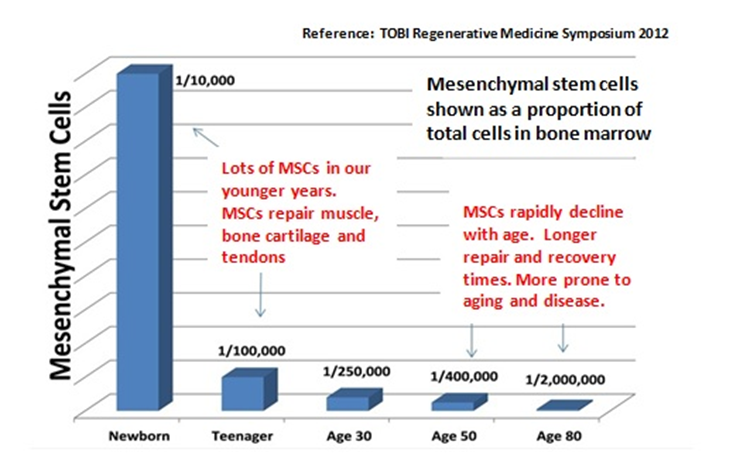
These changes are a key reason regenerative medicine is being studied. Because stem cells become less abundant and less active with age, researchers are exploring therapies that may support the body’s natural repair processes.
Benefits of stem cells
There are several potential benefits associated with stem cells:
- Reduce inflammation
- Modulate the immune system (strengthen it
when/where weak, and dampen overactivity) - Anti-microbial
- Regenerate tissues
- Anti-aging due to the ability to repair damaged
tissue - Stimulate angiogenesis (i.e., formation of new
blood vessels, which then carry oxygen and other nutrients to tissues for
healing and optimal function) - Stimulate your own stem cells to work better and
harder
These characteristics are also why regenerative medicine for pain has become a growing area of research. Patients dealing with chronic joint pain, inflammation, or musculoskeletal conditions are increasingly asking whether stem cell-based approaches might offer an alternative to long-term medication or surgery.
Risks of Stem Cell Therapy
Like any medical procedure, stem cell therapy carries potential risks.
Some possible concerns include:
- Infection (extremely rare. You are at risk of infection any time you have any type of injection with a needle)
- Lack of benefit for various possible reasons
- Growth of unwanted tissues
- Transient fever or flu-like symptoms
Understanding both the benefits and risks is essential when evaluating new medical therapies. People researching stem cell injections in Texas often discover that the science is still evolving and that careful evaluation is important before pursuing any treatment.
Various Applications For Which Stem Cells Have Been Used And/Or Studied
Stem cells have been studied or used in connection with a wide range of conditions, including:
- Cancer treatment
- Chronic inflammation (e.g., autoimmune disease,
fibromyalgia) - Arthritis in various joints
- Healing of torn ligaments and tendons
- Neurodegenerative diseases (e.g., Alzheimer’s, Parkinsons, stroke, etc.)
- Aesthetic procedures (e.g., improving skin appearance, facilitating better results with face lifts)
- Autism
- Diabetes
- Emphysema
- Wound care
- Spinal cord injuries
- Heart disease, heart failure
Among the most discussed applications is regenerative medicine for pain management — particularly for joint conditions, sports injuries, and degenerative diseases where conventional treatments have provided limited relief. A Wharton’s jelly injection, derived from umbilical cord tissue, is one approach being studied in this context for its potential anti-inflammatory and tissue-supportive properties.
Many patients reading about these studies eventually begin researching stem cell injections in Texas, particularly as more clinical trials and studies continue worldwide.
The Controversy Surrounding Stem Cells
Stem cell therapy is also one of the more controversial areas of modern medicine.
Several factors contribute to that controversy:
- There are currently thousands of ongoing studies using stem cell therapy for various diseases
- Big Pharma wants its piece of the pie
- Large universities are fighting for patents to get their piece of the pie
- Researchers are working on manipulating stem cells to become patentable drugs
- Embryonic stem cells are controversial in their own right and are illegal in the US. They are still used in other countries.
- There have also been isolated stories reported in the media, such as individuals who experienced complications during experimental procedures. In one well-known case involving three patients who underwent experimental injections into their eyes, investigators suggested that a chemical preservative—not the stem cells themselves—may have caused the damage.
- Tumor growth associated with stem cell use has primarily been linked to embryonic stem cells.
- Stem cells are not currently FDA-approved therapies in most contexts because they are natural biological materials rather than pharmaceutical drugs. As a result, many uses are considered “off-label.”
Another ongoing debate centers on whether it is better to use a patient’s own cells (autologous stem cells derived from fat tissue) or donor-derived cells such as umbilical cord tissue.
Proponents of autologous stem cells argue that using your own cells avoids theoretical risks of communicable disease. On the other hand, advocates of donor-derived cells point out that younger stem cells may be more biologically active than those from older individuals.
Studies have shown that, in laboratory settings, younger mesenchymal stem cells may exhibit stronger regenerative activity.
Continuing Research in Regenerative Medicine
According to Dr. Neil Riordan in his 2017 book Stem Cell Therapy: A Rising Tide, over 40 studies on the use of mesenchymal stem cells (MSCs) across various conditions reported no serious adverse reactions.
In particular, umbilical cord mesenchymal stem cells appeared to have the highest safety profile among several commonly studied MSC types, including:
- bone marrow
- adipose tissue
- menstrual blood
- umbilical cord tissue
Dr. Riordan also noted that a 2012 meta-analysis including eight randomized controlled trials of MSC therapy detected only transient fever as an adverse reaction.
Researchers found no evidence of cancer, immune reaction, organ system complications, toxicity, infection, or death associated with those treatments.
Learning More About Stem Cell Therapy
Regenerative medicine remains an area of intense research and discussion. While stem cells hold remarkable promise, the science is still evolving, and many questions remain.
At The Woodlands Institute for Health & Wellness, our team spends a great deal of time studying emerging therapies and evaluating how new research fits into real-world patient care.
If you have questions about regenerative medicine or would like to speak with our team about your health concerns, contact us today!
References:
Stem Cell Therapy: A Rising Tide by Dr Neil Riordan
The Healing Miracle docuseries
stemcellsjournals.onlinelibrary.wiley.com/doi/full/10.1002/sctm.16-0492
cellmedicine.com
predictivebiotech.com